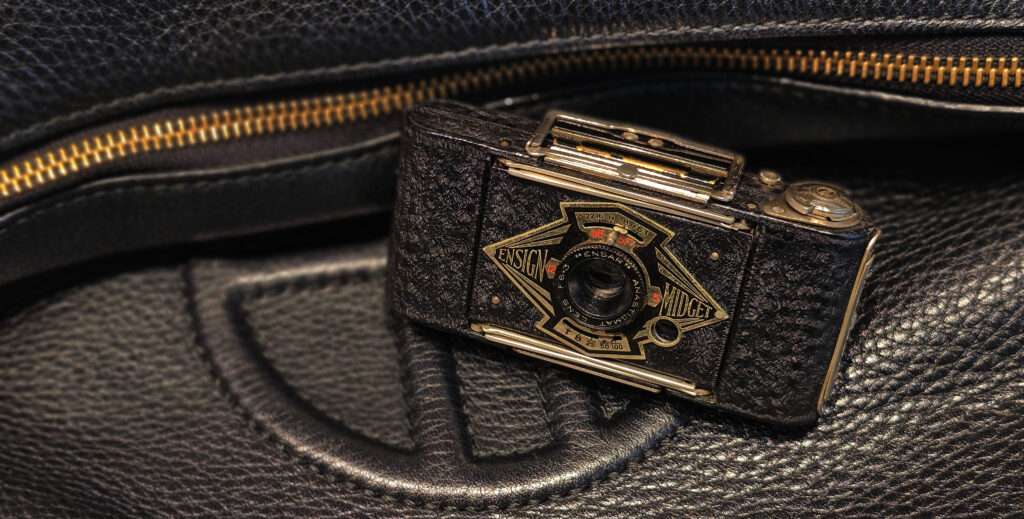
When I visited my friend Burkhard in the spring of 2026, I came across a camera in his collection that I had never seen before. It looked like a beautiful little Art Deco-style toy. But when I opened the back cover of his Midget 33, I was completely blown away. I knew right away that I had to have a camera like that. At the time, though, I had no idea what else was in store for me.
I just had to have it
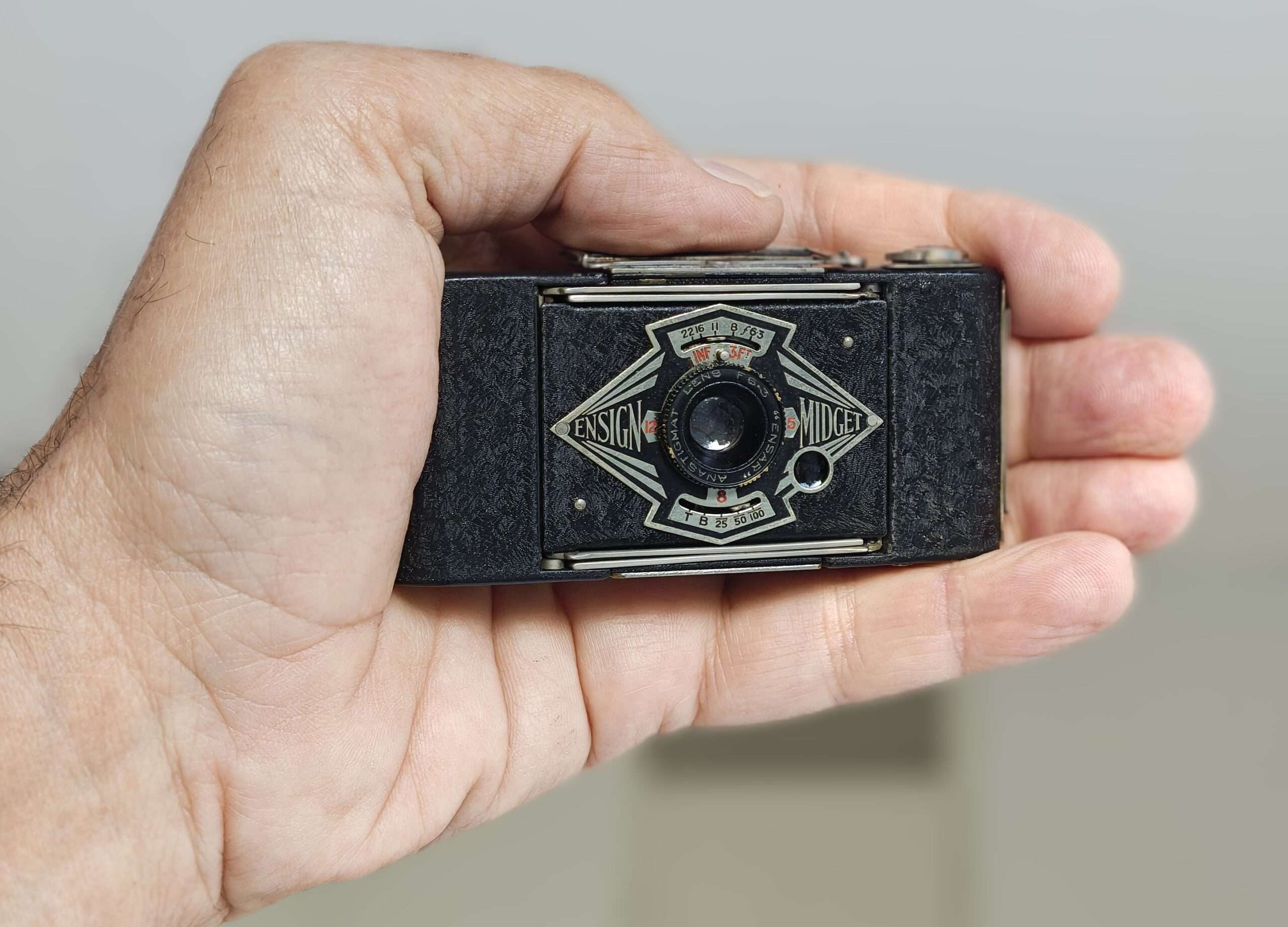
Various models of the Ensign Midget were available. I really wanted the Model 55 because it is the most complete model in the series, with distance, aperture and shutter speed adjustment.
Since the camera was manufactured in the UK and sold mostly there, it’s no surprise that I also bought my Midget 55 online there (for £35). By the way, in 1934, the Midget 55 cost exactly 55 shillings, which is equivalent to about €300 in today’s purchasing power.
A tiny giant
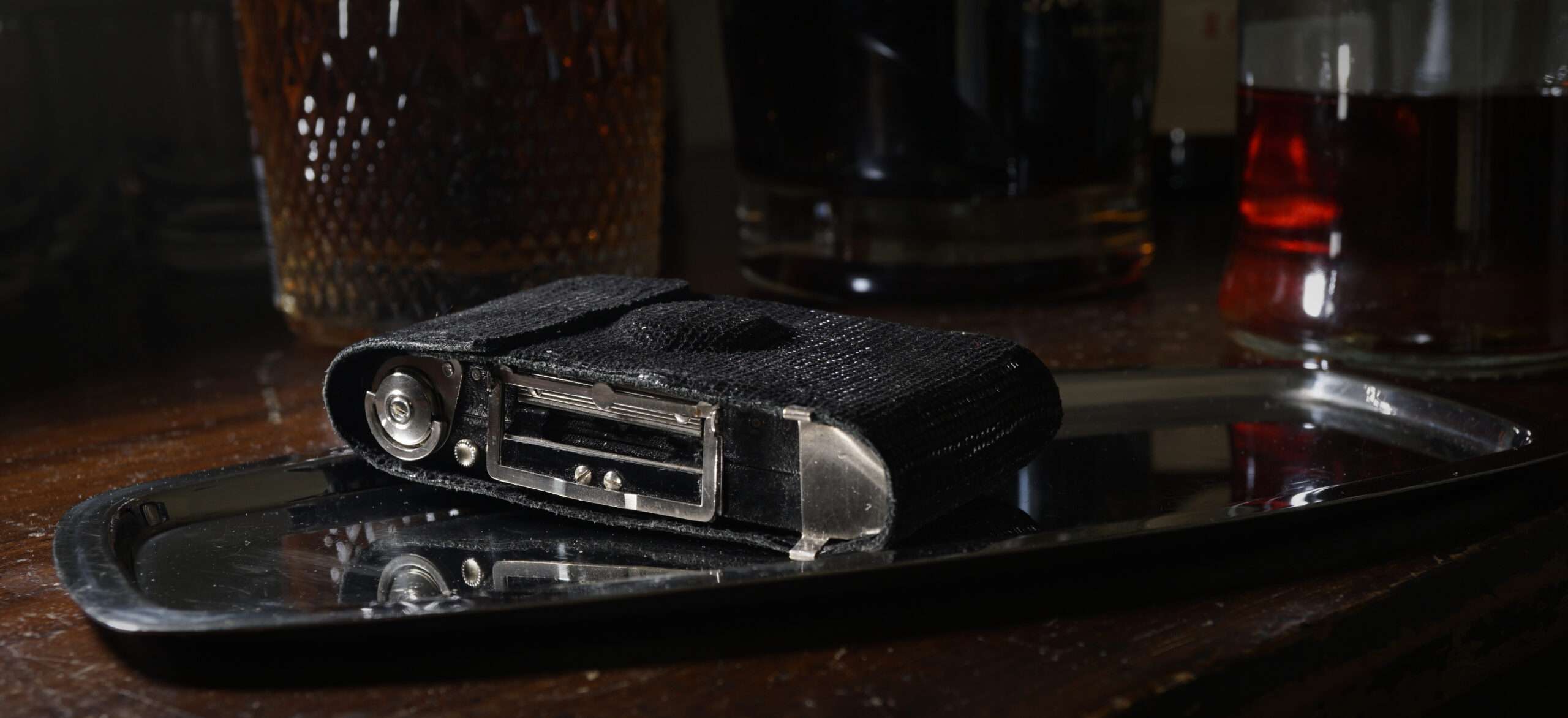
The Midget is merely 3.5 x 1.75 x 0.75” (90 x 40 x 15 mm) in size when folded. But when I first saw the Midget 33 with its back panel open, it took my breath away.
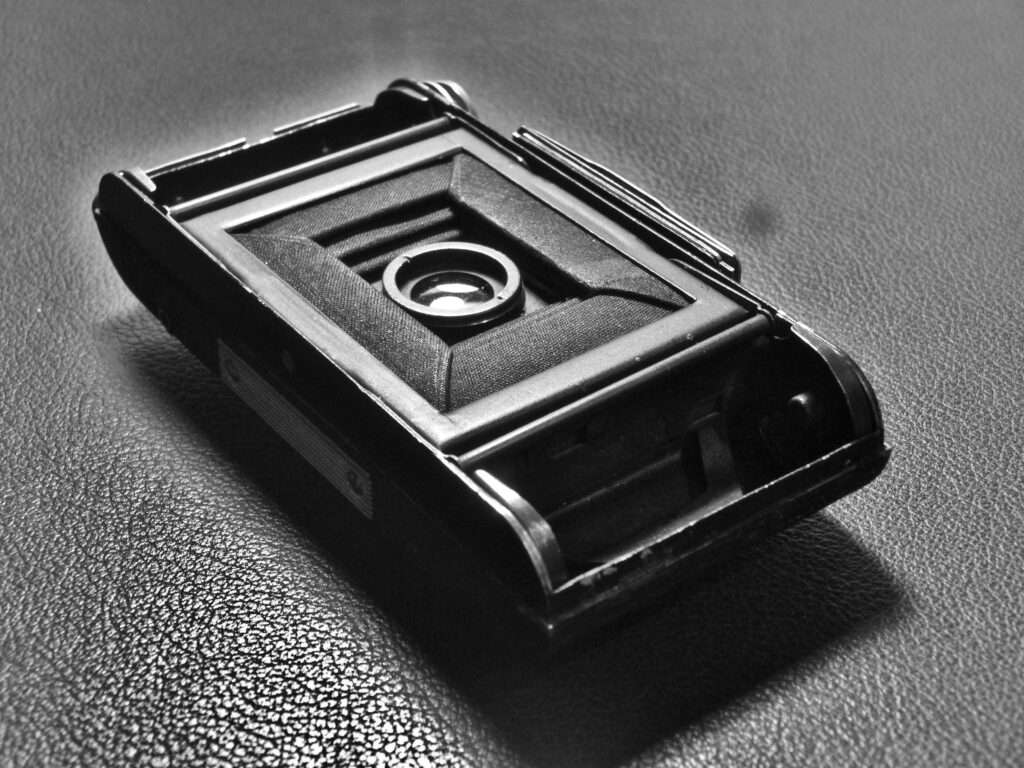
The film gate is gigantic! It measures (41.3 x 31.75 mm). That’s even significantly larger than 35mm format.
When viewed from this perspective, the Midget appears in a whole new light. Equipped with a reasonably good lens, this camera should take excellent pictures. We’ll look into this later. For now, however, let’s close the back cover again and turn our attention to the camera’s exterior.
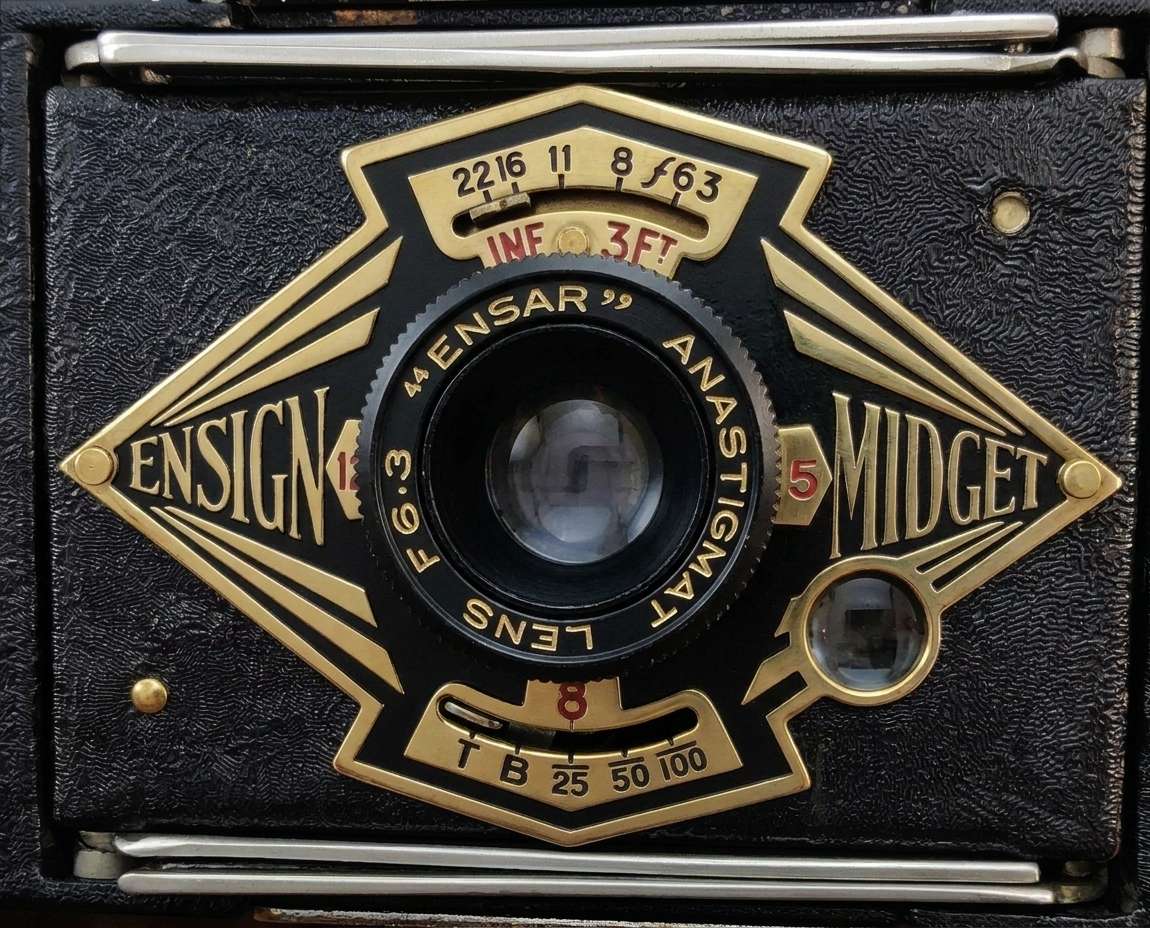
A stylish beauty

Ensign 1935 leaflet
The negative’s size
One would have to compare the size with other cameras from that era and relate it to their negative formats. Now, have a look at a Minox, an Ensign Midget, and a Leica side by side:
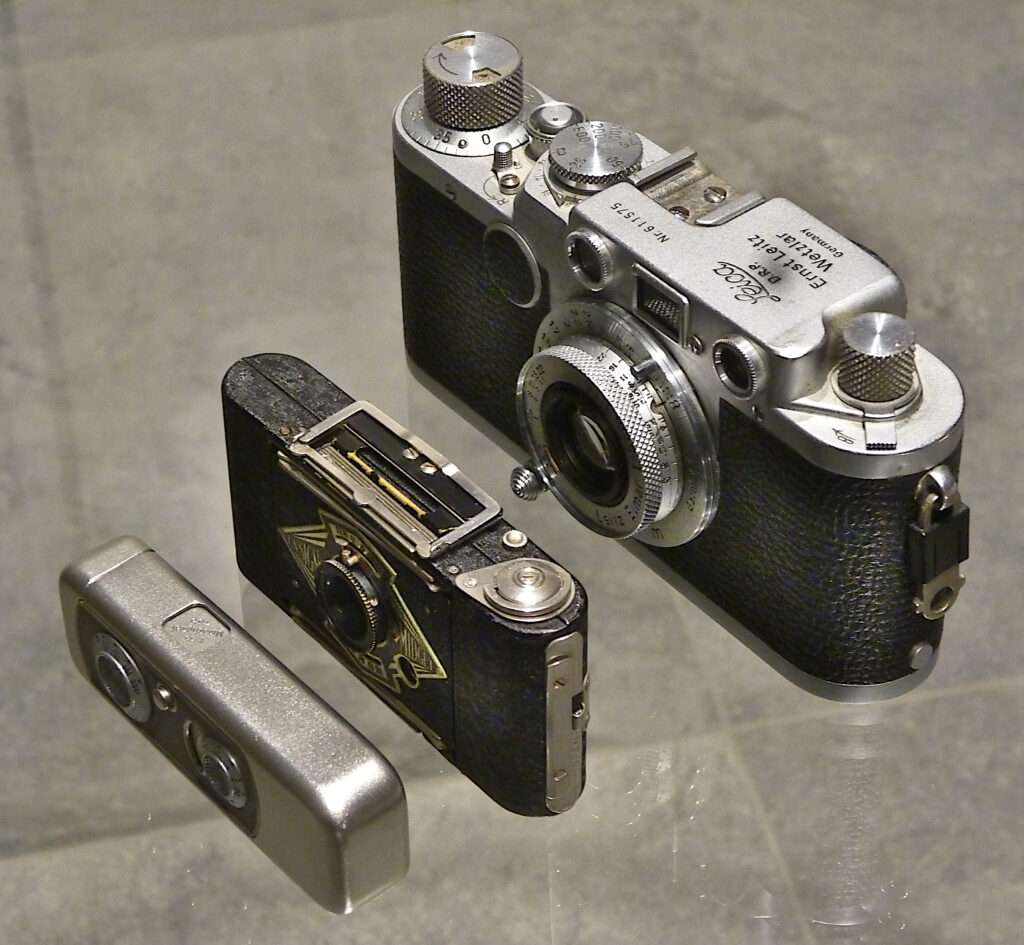
Who would have thought that the Ensign Midget produced the largest negatives of them all? Here is a direct comparison of the three negative formats:
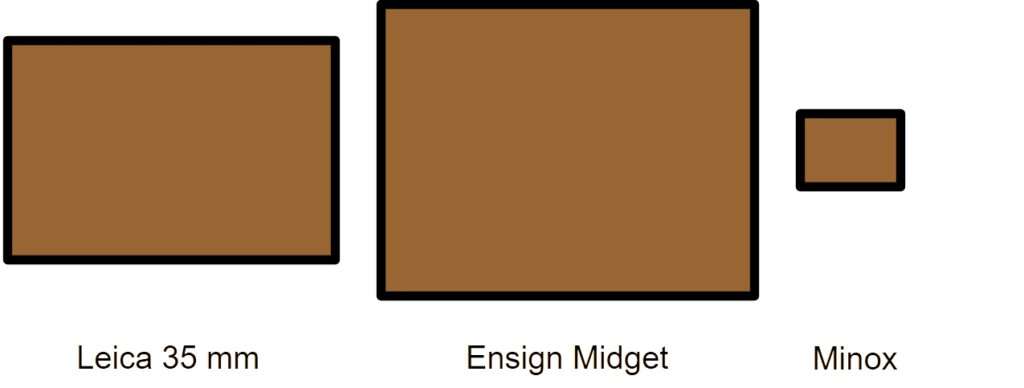
So what does that mean? Let’s compare the sizes of the Minox and the Midget. The Midget (69 cm²) is a bit larger in volume than the Minox (37 cm²). However, the Midget’s negative is almost 4 times larger than that of the Minox. Assuming both lenses have the same resolution and the same film is used, the photos taken with the Midget could therefore be enlarged 4 times as much. Or to put it another way, the Midget photos would be technically much better. Under these conditions, the Midget would actually take better pictures than a 35mm camera.
The big question: How good is the lens?
Whether the Midget is better—and by how much—depends on the quality of its lens. As mentioned, the Midget 55 has the best lens in the series. It’s an 53 mm Ensar Anastigmat f6.3 that can be stopped down to f22.
Since there are no reviews of this lens—at least none that I’m aware of—I tested it myself. Since I had already tested the lens on the VEF Minox Riga earlier, it’s easy to compare the results. You can find a description of my testing method here. I’ve presented my test results with the Minox here.
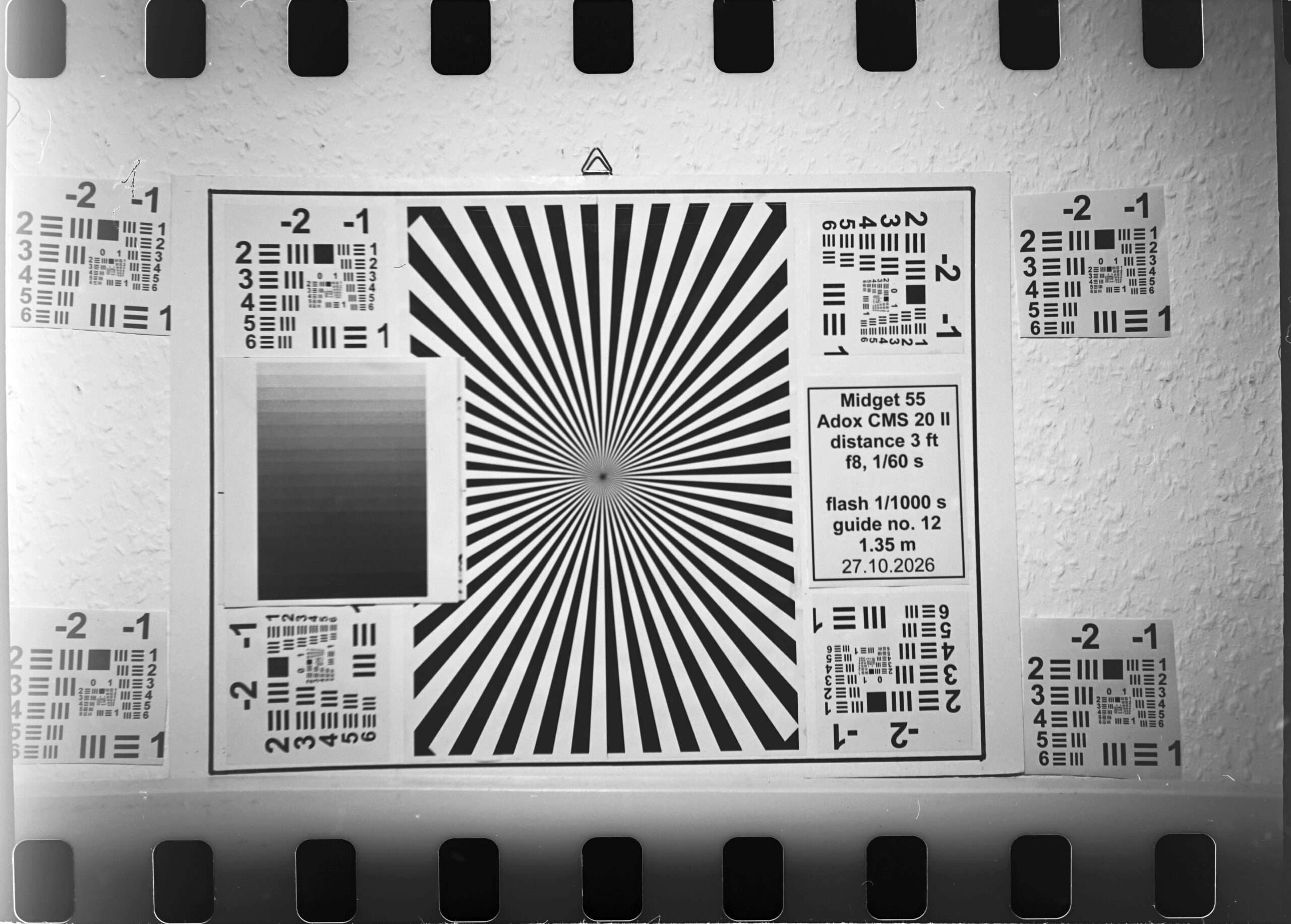
The tests show remarkably good results for the Ensar Anatigmat f6.3 on the Midget 55. I measured an air resolution of 110 LP/mm at the center of the image, which drops to 50 LP/mm at the edges.
By way of comparison: the best all-around lenses of the 1930s—for example, those from Zeiss and Leitz—had resolutions of 130 line pairs per millimeter (LP/mm) and between 30 and 60 LP/mm at the edges. That doesn’t seem much better than what the Midget achieves. However, it’s important to remember that these top-of-the-line lenses were much faster (up to f/1.5) and therefore naturally contained much larger elements. Smaller diameters are much easier to manufacture while maintaining the same quality.
Let’s now compare these values with those of the Minostigmat lens on the VEF Minox.
Vergleichen wir nun die Werte mit dem Minostigmat Objektif der VEF Minox.
Ensar mit Ektar: 110/105: 54 LP/mm
mit APX 400: 110/50: 34
Minostigmat mit Ektar: 225/105: 72 LP/mm
mit APX 400: 225/50: 41